
Freezer Cold, Fridge Warm? 7 Reasons This Happens!

You open the freezer and everything is still frozen solid. Then you reach into the refrigerator and realize the milk is warm, the drinks aren't cold, and the fresh food section doesn't seem to be cooling at all.
It can be confusing: How can the freezer be cold but the fridge be warm when they're part of the same appliance?
Turns out this is one of the most common calls we get here in Santa Cruz. And in almost every case, it comes down to one thing: the fridge doesn't cool itself. The freezer makes the cold air, and a fan (or a duct, or a small door called a damper) pushes that air over into the fridge side. When something along that path gets blocked or breaks, your freezer keeps doing its job just fine while the fridge slowly warms up.
Before assuming you need a new refrigerator, here are seven possible reasons this happens, what you can safely check yourself, and when it's time to call an appliance repair technician.
1. Blocked Airflow Between Compartments
Cold air travels from the freezer into the fridge through vents. If a food container, a box, or an overstuffed shelf is sitting in front of one of those vents, the fridge simply never gets its share of cold air.
Check this first: Look along the back wall of both compartments for vents, and make sure nothing — food, drawers, packaging — is blocking them. Give it a few hours after clearing anything out before judging the result.
Resist the urge to crank the temperature dial colder right away. If airflow is the real problem, a colder setting won't fix it.
Ice or Frost Buildup
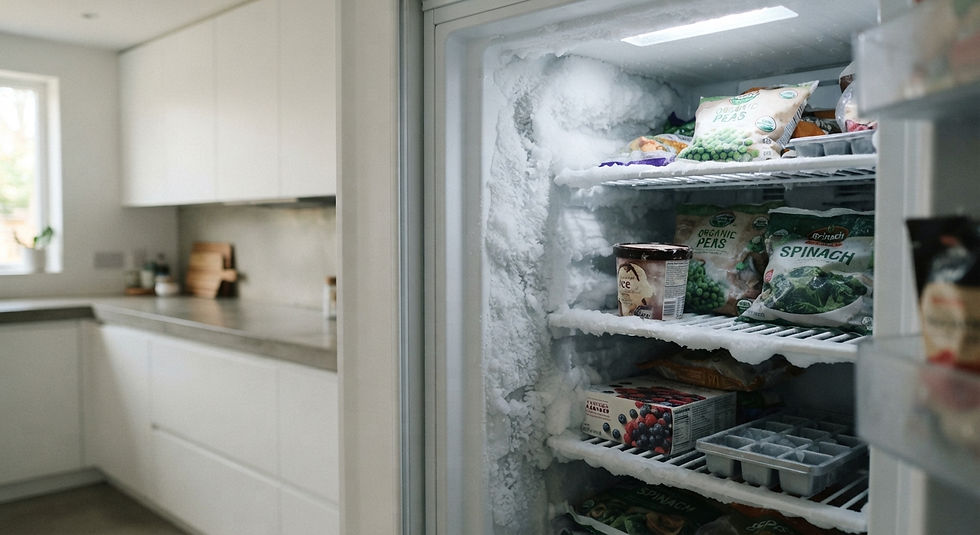
This is a big clue. If you spot frost creeping around the back panel of the freezer, ice around a vent, or unusual moisture — and the fridge is warm — you're likely looking at an airflow or defrost problem, not just a random ice patch.
Watch for:
Frost on the freezer's back wall
A clicking, ticking, or rubbing noise
The problem going away for a bit, then coming right back
That last one matters most. If this has happened more than once, wiping away the ice won't stop it from coming back — something is causing it to form in the first place, usually tied to the defrost system.
A Failing Evaporator Fan
Your refrigerator may be making plenty of cold air but failing to move that air where it needs to go.
That's where the evaporator fan comes in. And in many refrigerator designs, the evaporator fan circulates cold air through the appliance. If the fan stops working properly, the freezer may remain cold—especially for a while—but the refrigerator section can become noticeably warmer
A fan can fail electrically, develop a mechanical problem, or become obstructed by ice.
If ice has formed around the fan, you may hear clicking, scraping, squealing, or rubbing as the fan blade contacts the buildup.
The Air Damper Isn't Opening Properly
Many fridges use a small damper — think of it as a tiny door — to control how much cold air crosses from the freezer to the fridge. If it's stuck shut (mechanically or due to an electronic control failure), the freezer keeps humming along while the fridge barely cools.
This one's hard to diagnose by eye, since the damper, its sensor, and the control board all work together. It's usually a job for a technician with the right diagnostic tools.
The Fridge Is Just Too Full

Not every cooling problem means a part has failed. Sometimes the refrigerator simply can't circulate air effectively because there's too much food packed inside.
A refrigerator needs space around food and containers for cold air to move. Imagine trying to cool a room while someone stacks boxes directly in front of every air vent. The air conditioner may be working, but the room still won't cool evenly. The same principle applies inside your refrigerator.
Also check that nothing is preventing the doors from closing completely. This is one of the easiest things homeowners can safely investigate before scheduling refrigerator repair.
The Door Isn't Sealing Properly
A torn, dirty, or blocked door gasket lets warm, humid air sneak in every time the door closes. That extra moisture adds to condensation and frost, and forces the cooling system to work overtime.
Run your hand along the gasket and check for cracks, sticky residue, or spots that don't sit flush. Also check for the obvious: a bottle or drawer propping the door open just enough to break the seal. JUST INSPECT THE GASKET!
Tears or cracks
Loose sections
Food residue
Sticky buildup
Areas that don't sit flush against the cabinet
Here on the coast, this one's worth extra attention — the extra humidity in Santa Cruz air means a bad seal lets in more moisture than it would somewhere drier, which speeds up frost buildup.
A small amount of condensation isn't necessarily evidence that something is broken. But heavy or recurring frost combined with poor cooling deserves attention. If you're regularly clearing ice only for it to return, there's likely a reason the refrigerator isn't managing temperature or moisture correctly.
A Defrost or Temperature-Control Problem

If none of the above explains it, the issue is likely deeper in the system — a faulty thermistor, a defrost heater that isn't firing, a bad control board, or a sensor sending the wrong signal. These components all work together, and when one fails, the symptom often shows up somewhere else entirely (like a warm fridge instead of an obvious "broken" freezer).
A failure in one area can create symptoms somewhere else.
For example, if frost continues building around the evaporator because the refrigerator isn't defrosting correctly, airflow may eventually become restricted. The freezer can still seem cold while the refrigerator section starts warming up.
That's why replacing a part based solely on an internet search isn't always the best approach. The symptom tells us where to start looking. It doesn't necessarily tell us which part has failed.
What to Do Before You Call for Repair
Confirm the fridge has power and nobody bumped the temperature dial.
Check both compartments for blocked vents.
Look for frost or ice, especially on the freezer's back wall.
Make sure both doors close all the way and the gaskets look intact.
Listen for fan noise, clicking, or scraping.
One food-safety note: if the fridge has been warm for a while, don't rely on smell or looks to decide if food is still good. When in doubt, throw it out.
Should You Just Unplug It and Let the Ice Melt?
You can — and it sometimes works. Unplugging the fridge long enough for accumulated ice to melt can temporarily restore airflow. But if the same problem shows up again in a few weeks, that's a sign of a repeat cause (usually the defrost system), not a one-time fluke. Tell your technician exactly that: "Defrosting it fixes it for a while, then it comes back." That detail alone can save diagnostic time.
Is It Worth Repairing?
Usually, yes. A warm fridge with a cold freezer rarely means the compressor is shot — it's much more often airflow, a fan, a damper, or the defrost system. A technician can pinpoint which one it is so you're not stuck guessing between a $150 fix and a new refrigerator.
Call Santa Cruz Appliance Repair

If your freezer's cold but your fridge won't cool, we can find out why. Santa Cruz Appliance Repair is a locally owned, family-run company serving Santa Cruz and the greater Monterey Bay area. We repair refrigerators, freezers, washers, dryers, dishwashers, ovens, and stoves from most major brands.
📞 Call: 831-466-6095 (fastest for same-day booking)
💻 Request Service and we'll get your fridge back to normal.
Frequently Asked Questions
Why is my freezer cold but my fridge isn't? Cold air made in the freezer has to circulate into the fridge. If a vent is blocked, ice has built up, a fan has failed, or the damper is stuck, that air never makes it over — so the freezer stays cold while the fridge warms up.
Can too much food in the fridge cause this? Yes. An overpacked fridge blocks airflow just as easily as a broken part. Try clearing space around the vents before assuming something's failed.
Why does ice keep coming back after I clear it? Usually a door that isn't sealing, an airflow blockage, or a defrost system that isn't cycling properly. If it keeps returning, it's worth having someone look at the root cause instead of just clearing ice each time.
Does unplugging my fridge to defrost it actually fix the problem? It can temporarily fix it if ice was blocking airflow — but it doesn't explain why the ice formed. If the issue returns, the underlying cause needs to be diagnosed.
Who repairs refrigerators in Santa Cruz? Santa Cruz Appliance services refrigerators and other major appliances throughout Santa Cruz and the Monterey Bay area, including cooling, airflow, and defrost issues.



Comments